



Live That Adventure Logo
Adventure is not a hobby, it’s a lifestyle!
How to Hike Condor Gulch to High Peaks Loop, Pinnacles NP

How to Hike Condor Gulch to High Peaks Loop, Pinnacles NP

Pinnacles National Park is an underrated national Park in California. This park has dramatic scenery with jagged rock spires, mysterious caves, and is home to the endangered California Condors. If you can only do one hike in Pinnacles National Park, the Condor Gulch to High Peaks Loop trail is the one. The Condor Gulch to High Peaks Loop Trail weaves through the heart of Pinnacles National Park, offering not only unparalleled landscapes but also nonstop excitement from steep cliffside staircases, deep, twisted caverns, and a chance to see the California condors soaring above. 

Condor Gulch to High Peaks Loop is a strenuous hike with breathtaking views. There are a few options to complete this hike. The standard loop hike is about 5.3 miles and consists of the Condor Gulch Trail and High Peaks Trail. Some people prefer to only take the 1-mile hike to Condor Gulch Overlook and back. However, we recommend combining the standard loop with Rim Trail and Moses Spring Trail, which extends your hike to 6.2 miles. This extended loop takes you through the Condor Gulch viewpoint, the Steep and Narrow section, as well as adding on the tranquil Bear Gulch Reservoir, the dramatic entrance through Upper Bear Gulch Cave, and the mysterious Lower Bear Gulch Cave.

Compass
Table of Contents

Stats

Where

Trailhead Option #1
Pinnacle Moses Spring
36.478515, -121.183740

Trailhead Option #2
Bear Gulch Day Use Area
36.481338, -121.181184

Parking

Both trailheads have paved parking. The lot at Moses Spring trailhead is smaller than the one at Bear Gulch Day Use.

Hours

Opens 24 hours

Fee

There is a fee to enter Pinnacles National Park. For up-to-date pricing, check out the park’s website. You can also use your America the Beautiful pass!

Restroom

Vault toilets at both trailheads. There’s also a pit toilet at the junction of the High Peaks trail and Juniper Canyon trail.

Weather
Distance

To Overlook: 1 mile
Standard Loop: 5.3 miles
Extended Loop: 6.2 miles

Elevation Gain

1670 ft

Level

Hard

Time

3-6 hours

Ideal Time

Spring and Fall are the best times to visit because the weather is cooler. In the Spring, you’ll also get to see wildflowers. Get to the trailhead early, though, it might be very busy. If you want to check out the Bear Gulch Cave, make sure to check out the cave’s status to make sure it will be open when you’re going.

Pet-friendly?

Leave your pet at home. They are not allowed on the trail!

Getting There

The Condor Gulch to High Peaks Loop in Pinnacles National Park takes you through two different trailheads/parking areas: the Moses Spring and Condor Gulch  Bear Gulch Day Use Area. Since this is a loop, you can start at either trailhead. Bear Gulch Day Use Area has more parking. Both of these trailheads/parking areas are located on the eastern side of Pinnacles National Park, near the park’s campground. 

This area can get very busy during peak season or on the weekend. We recommend getting to the trailhead early. During peak season (late winter and spring), a shuttle service is available. It’s available from 8 am – 5:30 pm Friday through Sunday. This shuttle starts from Pinnacles Campground.

The Adventure

Condor Gulch to High Peaks is a loop trail. So, you can start from either direction. We went counter-clockwise, leaving from the Condor Gulch trailhead. This is because we wanted to save the Bear Gulch Cave for last. The Condor Gulch trailhead is located across the road from the Bear Gulch Day Use Area and Nature Center.

To Condor Gulch Overlook

As soon as we crossed over a short bridge, the trail began to ascend. Even though the climb isn’t that steep, it is constant. On the way to the overlook, you will be gaining just over 500 feet in less than a mile. Luckily, this short mile is full of wildflowers in the spring, tall blowing grass, and pinnacles and mountains such as Hawkins Peak. Along the way, there are a few switchbacks with very little shade. If you are visiting during warmer months, we recommend starting your hike early to beat the heat. Also, don’t forget to bring A LOT of water! When hiking, make sure to keep an eye out for poison oak. They were lining the trails when we were there.

Around 0.5 miles, the trail gets steeper. As we made our way through the switchbacks, we started to see a dramatic amphitheater of rocks. This is where the Condor Gulch Overlook is. At 1 mile, we reached the junction for the Overlook. Here, you can get a beautiful panoramic view of the park. And if you’re here at the right time, you can also see the California Condor. When we were here, a nice hiker gave us tips on how to tell the difference between California condors and turkey vultures. Besides condors, the Condor Gulch to High Peaks Trail also has tons of turkey vultures. California Condors have a white strip on the shoulder of their wings. They also fly gracefully. Turkey Vultures, on the other hand, have white or silver feathers on the trailing edge (bottom) of their wings. They also wobble when they fly, like a drunk person.

From Condor Gulch to Junction for High Peaks Trail

We spent quite a while at the overlook learning about and looking for the condors. Sadly, we had to leave because we still had over 5 miles more to go. From the Condor Gulch overlook, it is another 0.7 miles to the junction for the High Peaks trail. You’ll also be gaining another 500 ft. Along the way, we were treated to a gorgeous view of Bear Valley to the east and Chalone Peak, the highest point in the park, to the South. The trail eventually curved off to the right and went right alongside a split rail fence. When you see this, you are almost to the top…. Or at least the top of this trail. At 1.7 miles, we reached the junction for the High Peaks Trail. Here, make sure to stay left to head toward the Juniper Canyon Trail.

High Peaks Trail to the Steep and Narrow Section

After turning left, the Condor Gulch to High Peaks Trail gets more beautiful. The trail meanders through the heart of Pinnacles National Park, with giant boulders, jagged spires, and pinnacles. This section reminds us of Chiricahua National Monument, with its moss-covered spires. There are some really unique rock formations here. This is why there are many climbing routes in the Pinnacles National Park. These climbing routes are marked with a sign that has a carabiner on it. We came across many of these along the trail. We didn’t bring our climbing gear, so we just stared lovingly at the rocks for a bit before continuing.

At 2.5 miles, we reached the junction for the Tunnel Trail. The Tunnel Trail connects to the western side of Pinnacles National Park, where you can access the Balconies Cave. Here, we keep left to stay on the High Peaks Trail. This is the start of the Steep and Narrow Section on the Condor Gulch to High Peaks trail.

First Part of the Steep and Narrow Section

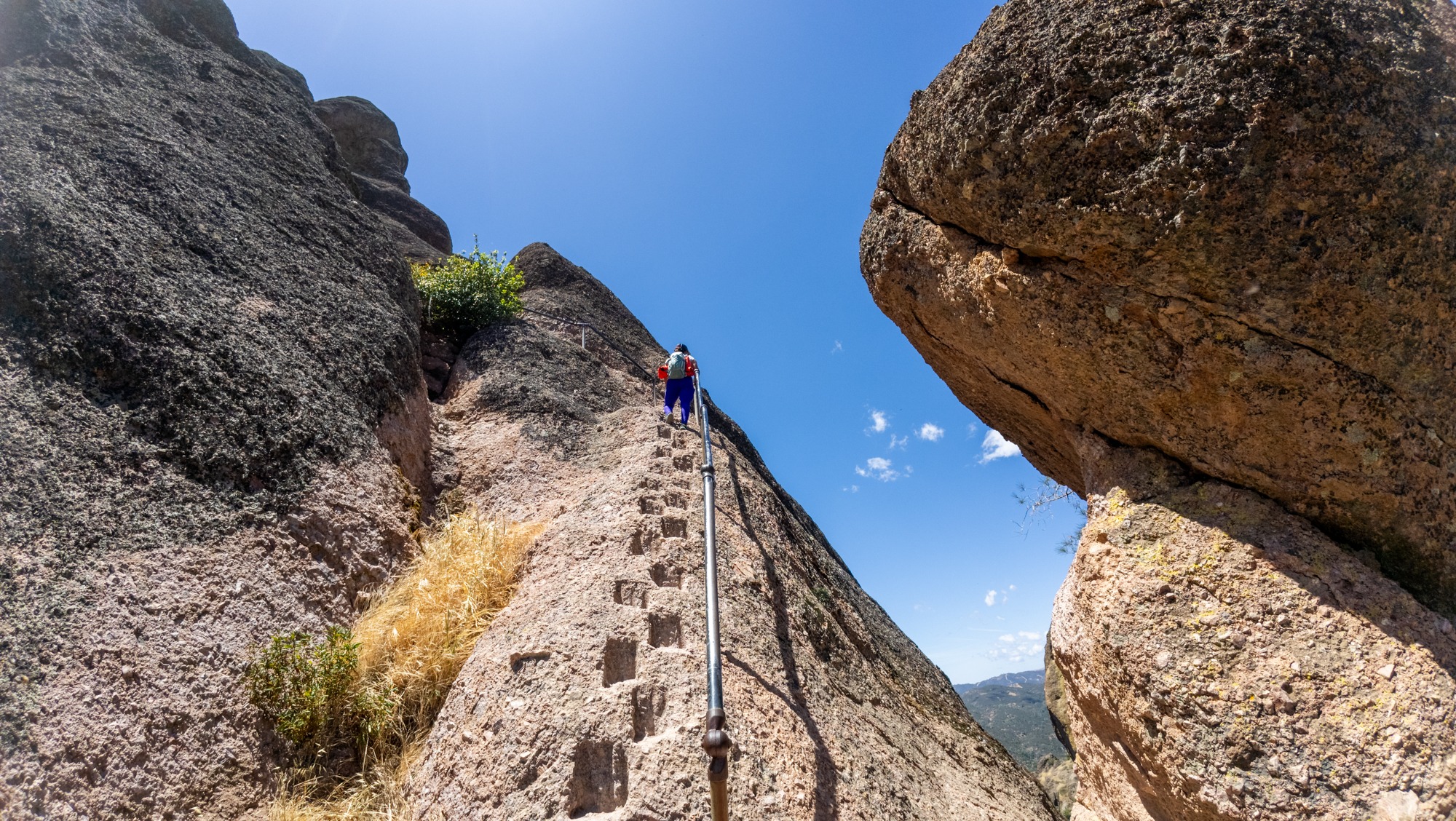
As soon as we left the junction for the Tunnel Trail, the High Peaks Trail ran along the edge of the cliff and snaked through giant boulders. It cut through a narrow notch between the high walls before dropping downhill. After this short downhill section, we found ourselves at a set of stairs carved into the rocks. Once we got up to the top of these steps, we got to one of our favorite parts of the Condor Gulch to High Peaks Trail. Here, there are footholds cut out from the spine of an almost vertical rock outcrop. There is a metal rail running along the footholds to assist with the climb. It looks sketchy, but the climb is quite straightforward and not that hard. 

Immediately after this first railing section, we reached the second one. This second railing is shorter and leads up right underneath an overhang. There are steps carved out right below the overhang, forming a narrow trail. Don’t forget to admire the views as you climb higher. We also recommend looking back toward the rocky outcrops. We spotted a California Condor hanging out in the tree there. They seem to like hanging out at higher places. We also saw two of the condors on the trail to Balconies Cave.

Second Part of the Steep and Narrow Section

After this narrow section, the High Peaks trail descends a set of stairs before climbing back up again for a short distance. Here, you can look out to your left and have breathtaking, panoramic views of the pinnacles and the valley below. The trail once again snakes between big boulders before leading down the third railing section. This section is also steep with steps carved into the rock, similar to the other sections. Even though it is steep, the descent is not that bad.

Once past the railing section, the High Peaks trail continues downhill through a series of rocky steps, a dirt path, and one last railing section. Then, the Condor Gulch to High Peaks trail once again picks up its elevation for a short distance. Here, we were back on the ridgeline, with expansive views. 

At 3 miles, the Steep and Narrow section ends. We soon came upon a couple of junctions, one for Juniper Canyon and Tunnel Trail. You’ll want to head up a little further and follow the sign for Bear Gulch Area. This trail also goes past a pit toilet.

To the Junction for Bear Gulch Area

After we turned left to follow the Condor Gulch to High Peaks trail toward Bear Gulch Area, the trail began its steady descent. We followed the trail down a series of switchbacks with dramatic views of the rising pinnacles. Once again, the poison oaks are back. So, make sure you pay attention. Following the switchbacks, the High Peaks trail passes through a short but really cool tunnel. Along the way, we came across a few interesting rock formations and a climber’s access trail.

At about 5 miles, we came to another junction. Here, if you keep going straight, you’ll get back to the parking lot via the standard loop. For the extended loop to the Reservoir and Bear Gulch Cave, go right to follow the Rim Trail. It is about a 1-mile detour, but 100% worth it! This 1 mile is packed full of action!

Bear Gulch Reservoir & Upper Bear Gulch Cave

It is about 0.6 miles from the junction to the reservoir. As the trail descends, the view opens up to an idyllic blue lake below. The Bear Gulch Reservoir is nestled between the gray, jagged rocks, making for a stark contrast with its vibrant blue water and lush green vegetation. We recommend taking some time here to admire the serene scenery of the reservoir. 

Once you’re ready to move on, you can either cross over the bridge and continue along the trail. Better yet, right at the start of the bridge, there is a small trail leading down to a steep staircase. If you’re on top of the bridge, you can look down and see this staircase. The staircase leads down to the entrance of the Upper Bear Gulch Cave.

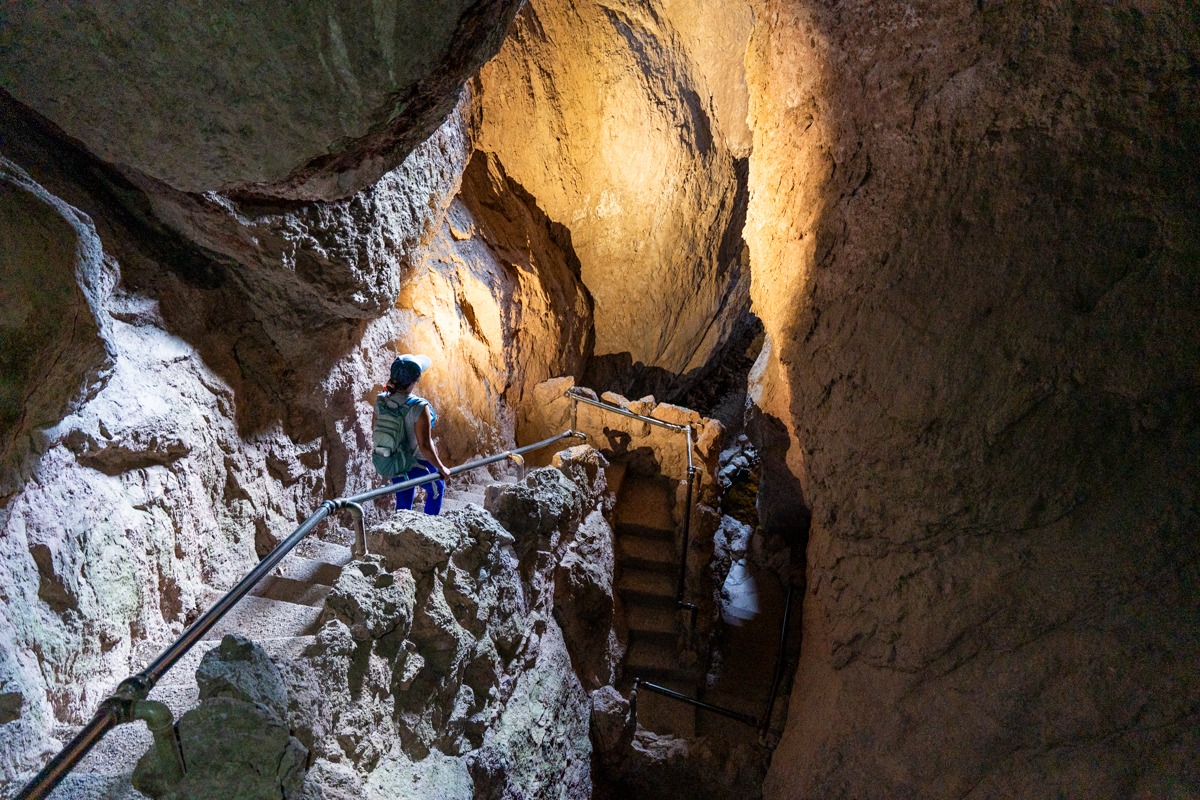
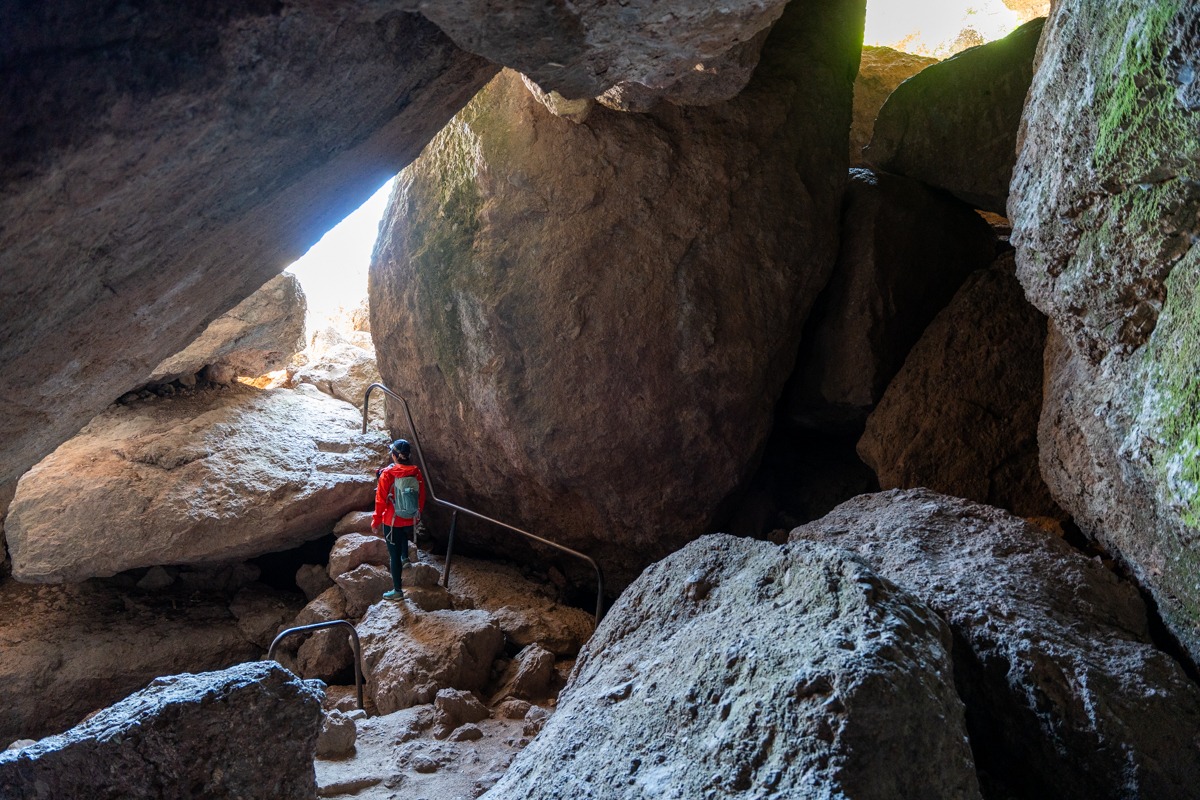
Upper Bear Gulch Cave closes most of the year, so you probably can’t enter. However, you can still go down the stairs and follow the trail to connect to the other side of the loop. This section is really cool. The staircase runs along a lush gorge with trickling water. At the bottom of the staircase, the trail ducks under big boulders stacked atop each other. It gets quite dark in there. Once in, follow the trail to the right as it snakes through mossy boulders and corridors.

Lower Bear Gulch Cave and the Rest of the Loop

Soon, the Condor Gulch to High Peaks trail opens back up for a short distance. Then, we reached the entrance to Lower Bear Gulch Cave on the right. If you don’t want to go to the cave or if it’s closed, you can continue straight (left). We cover both options in our blog for the Lower Bear Gulch Cave. On this hike, we decided to hike through the Lower Bear Gulch Cave. We highly recommend doing so. In our opinion, the Lower Bear Gulch Cave is much more interesting going in this direction. There’s something about climbing down an open cavern in pitch black, not knowing where it ends. It was kind of cool. Well, at least we think so.

Once you get back to the parking lot at Moses Spring, if you park at the Bear Gulch Day Use Area, you can cross over to the other side to follow the trail back. This trail runs along the main road; however, it is safer because you won’t have to compete with cars.

If this is your first time visiting Pinnacles National Park, check out our complete guide. For similar hikes like this, we love the Big Loop in Chiricahua National Monument. If you’re taking a road trip from Southern California, don’t forget to stop by Gaviota Wind Caves! That is such a cool hike!

Happy Adventuring. Don’t forget to check out the related posts below for more inspiration on your upcoming adventures. While at it, follow us on Instagram and subscribe to our YouTube channel! We’ll love you forever!

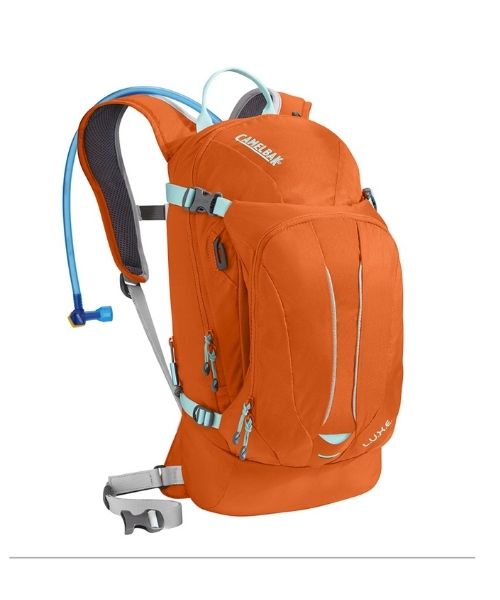
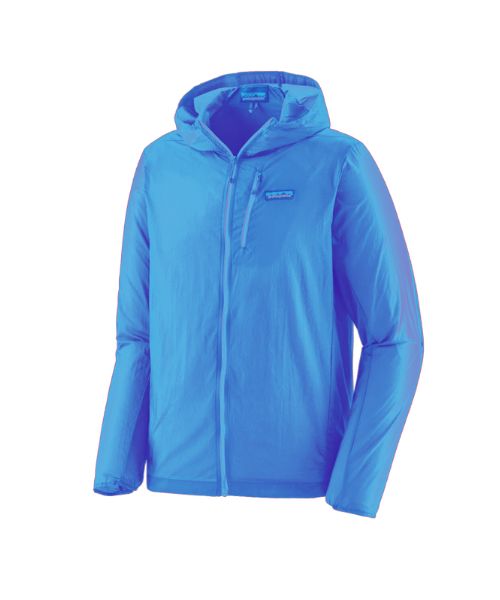
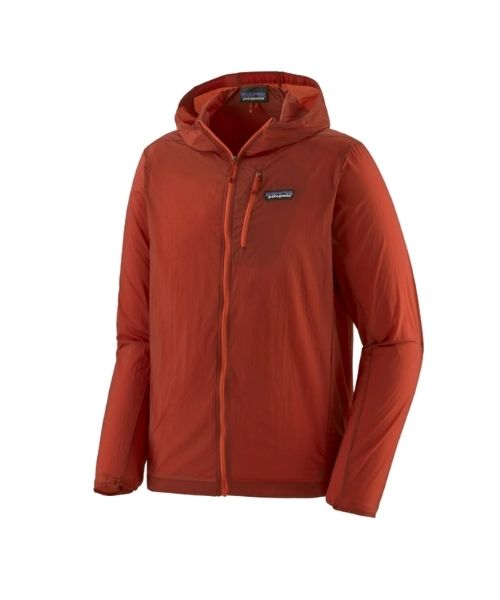
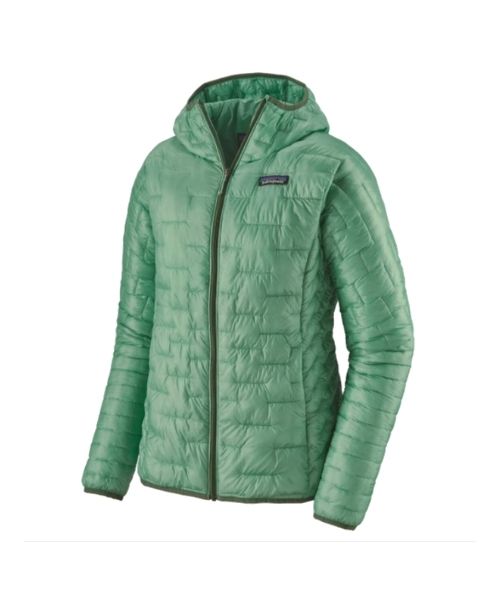
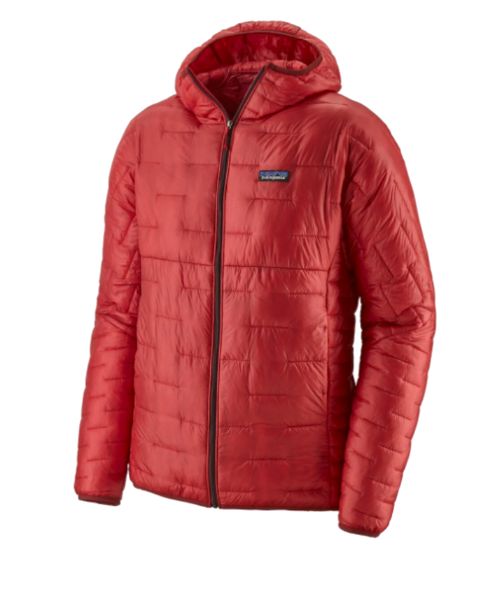
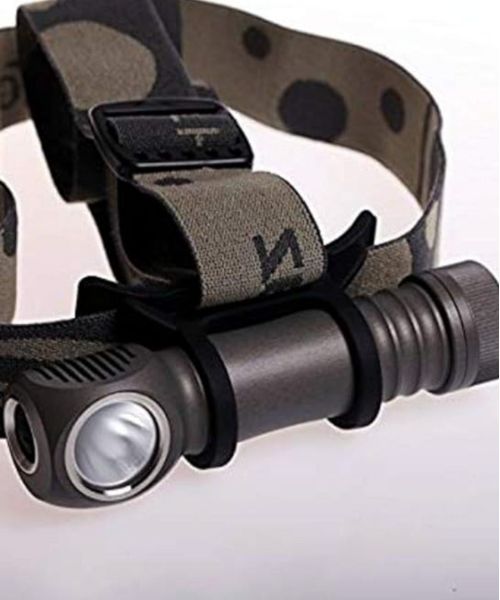
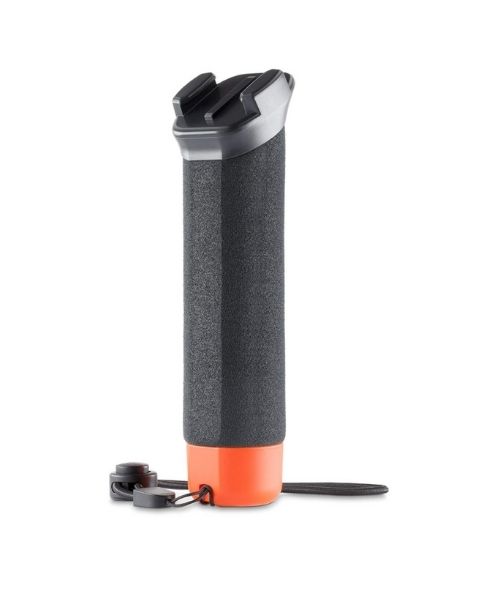
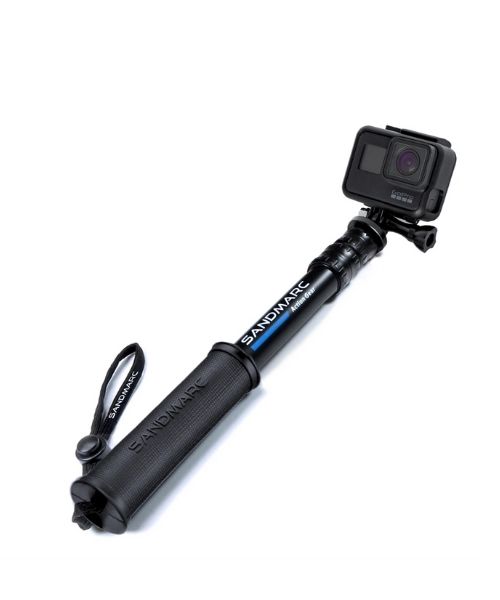
Recommended Gear

These are the gear that we personally use and find helpful for this particular adventure. Don’t forget to check out our Recommended Gear section as well.

Adventure Gear
  • All
  • Biking Gear
  • Camping Gear
  • Canyoneering Gear
  • Favorite Biking Gear
  • Favorite Canyoneering Gear
  • Favorite Hiking Gear
  • Favorite Kayak Gear
  • Favorite Road trips Gear
  • Favorite Water Gear
  • Hiking Gear
  • Main Favorite
  • Photography
  • Road Trips Gear
  • Travel Essentials
  • Water Gear
Camera Gear
  • All
  • Biking Gear
  • Camping Gear
  • Canyoneering Gear
  • Favorite Biking Gear
  • Favorite Canyoneering Gear
  • Favorite Hiking Gear
  • Favorite Kayak Gear
  • Favorite Road trips Gear
  • Favorite Water Gear
  • Hiking Gear
  • Main Favorite
  • Photography
  • Road Trips Gear
  • Travel Essentials
  • Water Gear

Nice to meet you!

Side bar: Our photo

Hi! We are Dustin & Vy, the proud creators of Live That Adventure. We created this website because we wanted to inspire others to live their lives to the fullest. On here, you’ll find everything from hiking, canyoneering, kayaking, and snorkeling to adventure and travel tips, gear reviews, and bucket list items such as bungee jumping or wing walking. We’ll show you the ropes so you can do them too!

Subscribe

Get our best adventure tips, guides and more send to you!

Related
Adventures
Share the Love

LEAVE A COMMENT

Your email address will not be published. Required fields are marked *